
It wasn’t until I had children and began studying ADHD and AuDHD that I really discovered what ‘executive function’ meant and what it looked like when it didn’t function properly at all. It is important to understand, as it is a large part of our lives, and executive functioning can be a huge mental load, especially for women who carry partners and children in their minds as well as themselves.
Before we go into what the challenges look like and how I discovered I had learned to cope in a very unhealthy way, let’s look into what executive function is, why it is important, and what it looks like when it is dysfunctional in a neurodivergent brain.
Executive Function is like the ‘manager’ of the brain. It is the name for the cognitive processes we undertake every second of every day, such as planning, focused attention, memory for events, dates, and what you need from the supermarket. It is in control of multitasking, managing our emotions, adapting to new situations, and solving problems. It is our personal assistant, project manager, systems analyst, and diary. You can see that executive function is important, especially for day-to-day organisation, whether that be school, work, or home administration. We as humans need to begin our day with a plan of what we will do, what comes next, what we need to remember, and focus to achieve it. We can go deeper into executive functioning from the macro lens of life to the micro lens of day to day tasks, as this is the system of the brain we use when we plan specific tasks. It may be a project at school or work. What is the first step I need to take, when is this project due, how do I organise all the information in my head into a coherent form and express that on a piece of paper so that someone other than me will understand it and follow along accordingly? How do I get organised steps done before it’s the last minute and then remember when the due date even is?
You can now see how executive functioning permeates our entire lives, and perhaps you can also begin to see why people with ADHD, AuDHD, and ASD have so much difficulty. It is known that these, and indeed other, neurodevelopmental conditions have what’s called ‘executive dysfunction’. Our brains are wired differently, and challenges with our executive functioning show up in our day to day lives frequently.
For example, executive functioning challenges may present as forgetfulness, planning and execution issues, emotional disregulation, anxiety around task switching, losing things, procrastination in starting tasks, or task avoidance, lack of organisation with physical things or thoughts, losing a train of thought or a specific word, concentration issues, hyperfocus, rigid thinking, impulsivity, and more. Looking at the example of a project for school or work, executive function even controls our ability to remember spelling, grammar, and sentence structure, so tasks that seem simple to some become huge to those with Executive Dysfunction.
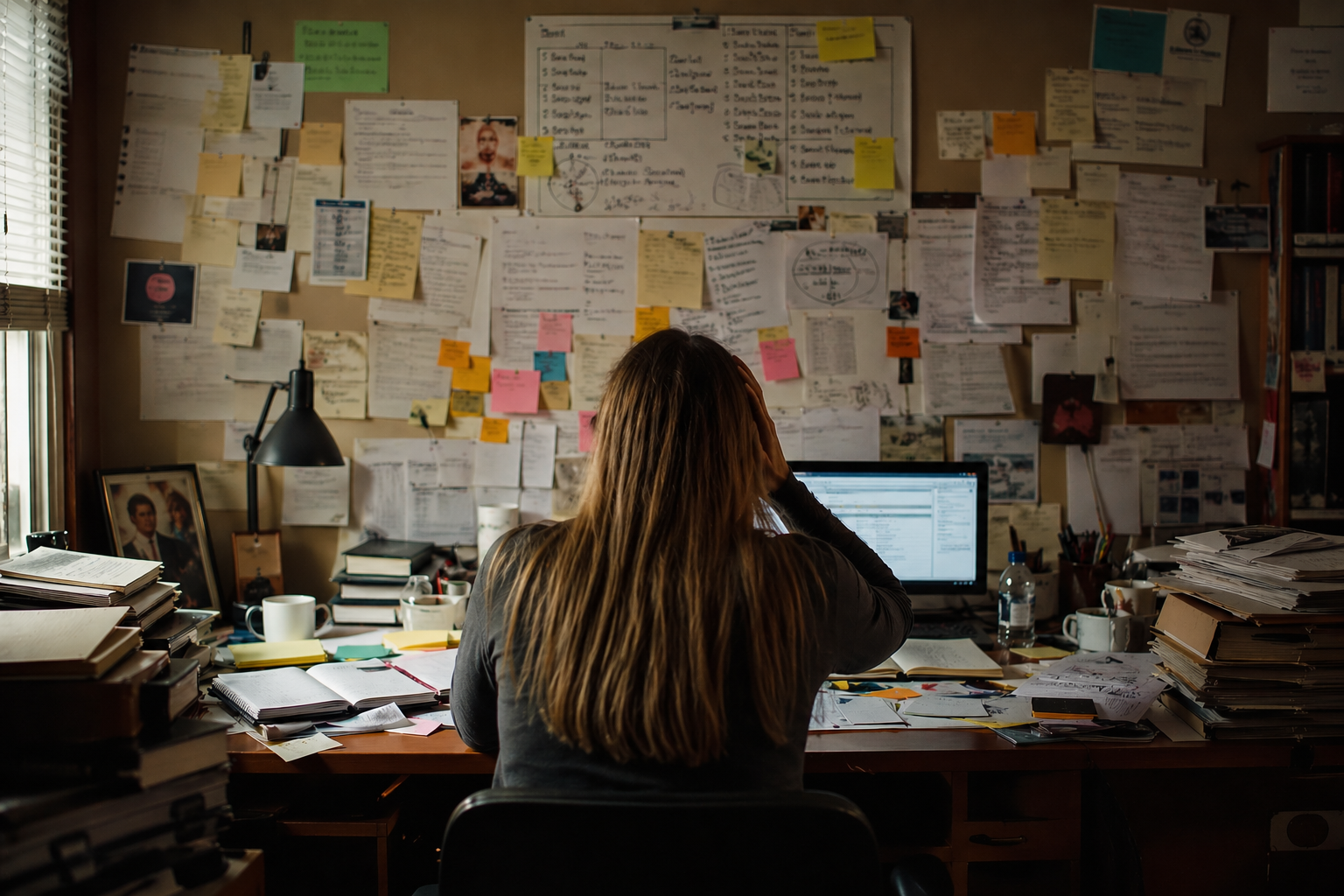
Imagine Executive Function is an office. In a neurotypical brain, the management systems have an organised flow. Everything has its place and is returned there when the task is completed, files are neat and organised, and easily accessed or retrieved when required. The office works as a system, and each system complements the other, making the flow smooth and controlled. In a neurodiverse brain, the office workers show up sporadically, their systems are loose or don’t exist, files are missing or incorrectly stored, and no one knows where what they need has been put or how to find it in a timely manner. It is simply disorganisation. The most important thing to remember about neurodiverse executive function challenges is that these are not ‘learned’ processes that can be resolved. The hardwiring of a neurodiverse brain means that we can develop systems to help where our wiring is failing us in executive functioning. As we mature, some aspects will improve, but we will never be able to rewire our brains to have them function like a neurotypical brain. In fact, these challenges are part of the reason Neurodiverse Coaching exists, as work included helping develop systems and tools within a person’s life to overcome these executive functioning pitfalls.
With an understanding of Executive Dysfunction in ADHD, AuDHD, and ASD, let me now look at how it affected me thought life, what tools, some unhealthy ones, I leaned on to get by, and how my story is not uncommon for neurodiverse women.
When I was young, I immediately had issues with school. I couldn’t focus, I would talk out of turn, and a lot, I would forget due dates, have trouble remembering information in my studies, and could not spell or do times tables to save myself. I now know this was all due to my AuDHD and executive functioning issues, but back then, I just thought it was me. That I was not smart, that I was lazy and disorganised, and that no matter how hard I tried, I wouldn’t be able to achieve what I perceived everyone else around me to do with ease. Unfortunately, as girls were not often looked at as being born with ADHD in the 80’s and 90’s, authority figures around me made the situation worse by calling me out on these issues regularly, like I was doing it on purpose. Laziness, stupidity, lack of application, not trying, were all frequent words spoken to me, right from the first day of school. For a young person’s developing brain and self-esteem, these words are at first confusing, then expected, then believed. By the end of my final year of school, I firmly believed I was the things people had told me, plus I had been diagnosed with anxiety, depression, and dyspraxia (now classified as Developmental Coordination Disorder or DCD). I had stopped Maths in school as soon as possible because my brain simply didn’t follow it, my spelling was terrible, and I could verbalise thoughts well but not seem to get the same thoughts down on paper in my essays as effectively. I was completely emotionally deregulated, with frequent sad and angry outbursts. To combat this, I chased dopamine to make me feel good, whether that be food, people, music, alcohol, or more, I tried it all. I finished school with a complete lack of awareness of who I was, what I was capable of, or any sense of ability or self esteem.
The next few years helped in that, once in a tertiary educational system, I discovered that my ideas and thoughts were more valuable than my ability to ‘fit into the box’ and rote learn facts. I was invited back to do Honours in my first degree and had found my sense of intellectual ability. All other self esteem was still missing, however and organisation of my life had taken a sharp turn. When I moved out, I needed to rely on my own systems to get places on time, hand things in and work for money. I began to find ways that worked for my brain to stay on top of all of these things, and as a pet hate of mine was lateness, I pushed to be on time or early for everything.
“We were never broken, just trying to function in systems that weren’t built with us in mind.”
By the time I was in my late 20s and about to have kids, my organisation had become all consuming. I had colour coded calendars, reminders on post-its as this was pre smart phones. I knew everyone's schedule and regularly broke myself to make sure people had what they needed before they knew they needed it. I was exhausted all the time, but a new word had become people’s best descriptor of me, ‘reliable’. I had become proud of this word, feeling that I had grown out of my old self, the disorganised, lazy and loud me. When I had kids, it went into overdrive. I now had to make sure that I had my schedule down, but also my husband's, so clashes didn’t occur. I booked social events, took kids to appointments, knew when they needed to be fed or changed, I bought presents for all occasions for all the family members, filled out all the forms, kept the house clean and tidy and generally ran everything like a military clock. A new word appeared as my descriptor, ‘obsessive’. Anxiety was high at all times and worse when something felt out of my control or was not as expected, like if someone didn’t put things back where they belonged, or if towels were left on the floor, or if I had given reminders but they had been ignored. When things slipped in other people’s lives, it became my fault for not being on top of it.
It wasn’t until my diagnosis of ADHD and ASD that I began to understand what had happened, and it made my additional diagnosis of OCD less of a surprise. I was masking the whole time. Every second of every day in an attempt to keep control of my life, to outrun the fear and anxiety that had been implanted in my brain as a child. To be ‘normal’, to show the world I was not broken or different, and it came at a cost. By 40, I was burnt out. Peri-menopause had set in, which already affects memory and emotions with hormonal changes, and I had nothing left to give. I was crying a lot, I was anxious all the time, my need for control and predictability was paramount and entering my 40’s in the COVID years had turned the volume up to 11. Rather than being gentle on myself, I had gone harder in an attempt to keep all the balls in the air, but things had begun to slip. I was forgetting more, I was tired all the time, I didn’t want to leave the house, I didn’t want to talk to people, I felt guilty for not being able to carry the load of the world. I needed to learn why I was in this state and what I could do about it.
Now, at 45, I am healing my behaviours, one day at a time. I am learning to delegate, to say ‘no thank you’, and to ask for help. It is REALLY not easy, and I slip into old patterns a lot. I still mask my behaviours and get exhausted socialising, I still find myself reaching for a dopamine hit in unhealthy ways, but I have tried to develop a small and close support network to help me when I fall. For me, recognising that there was a reason for these patterns of behaviour made a huge difference. The first step is acknowledging there is a problem after all. Executive functioning is not a cognitive function that can be perfected in a neurodivergent brain structure, however, so for me, it was about finding healthier ways to cope with the overwhelm. I have kept tools that work for me, and take restorative rest when I can.
My story is not uncommon for neurodivergent women. Society often expects girls to be quieter and more organised, and women, wives, mothers, carers, to be the ones ‘in control’ of households and families. The pressure on executive functioning doesn’t disappear with age, in many ways, it grows.
But this isn’t a personal failure, it’s a difference that has always been there. Understanding that changes everything. It allows us to seek support in ways that are actually helpful, to let go of expectations that were never built for us, and to move through the world with more clarity and self-trust.
We were never broken, just trying to function in systems that weren’t built with us in mind.
By Lauren Nielsen
As with all my blogs, I share this because it’s the foundation of how I work with clients now. Not from just from theory and professional expertise, but from a lived experience that has been understood, unpacked, and rebuilt.